Mining Road Terrain Stability and Landslide Risk Monitoring

Prevent supply chain disruption by identifying terrain hazards along logistics corridors before failure. Klarety processes SAR coherence and optical imagery to flag subsidence zones, slope instability signatures, and active landslide scarps along haul roads. Surveyors receive prioritized maintenance maps updated monthly.

Terrain hazard mapping for mine logistics corridors

Klarety AI
Klarety AI chat composer interface

Haul road risk reports from satellite radar

Klarety agents process SAR coherence over logistics corridors and return monthly terrain stability reports with maintenance priority flags.
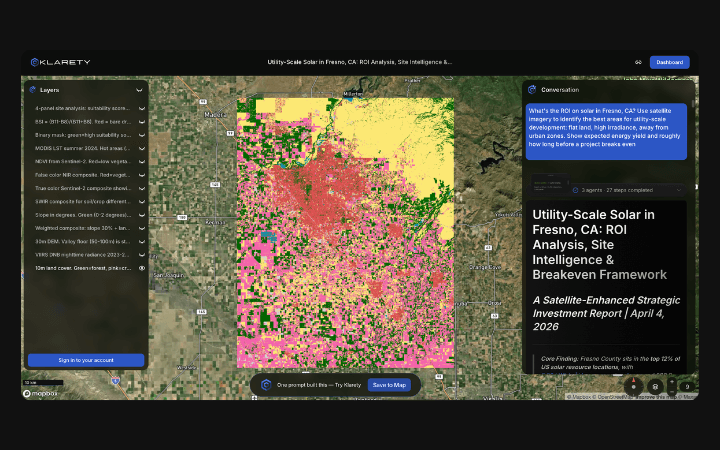
SAR Coherence
Klarety satellite analysis output

InSAR coherence loss for subsidence and slope failure

Agents compute interferometric coherence loss to detect active subsidence, slope movement, and landslide precursor zones.
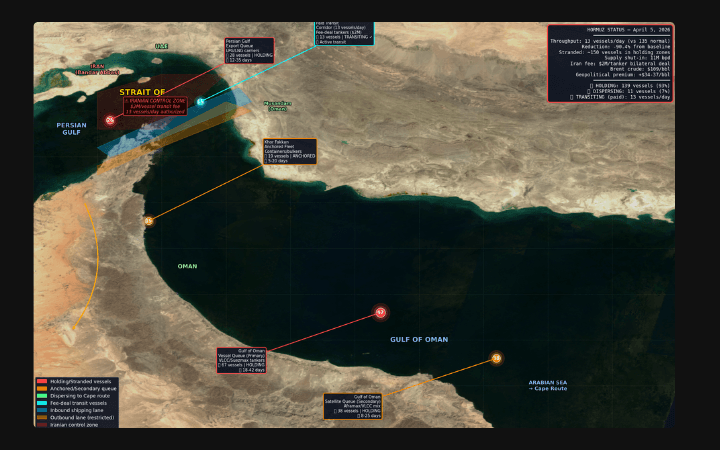
GIS Output
Klarety AI map annotation overlay

Hazard polygons for mine operations GIS

Export slope instability polygons and subsidence zones for haul road maintenance scheduling and mine operations GIS.

SAR coherence slope instability detection for haul roads

Klarety agents compute SAR temporal coherence loss from Sentinel-1 repeat-pass pairs over haul road corridors. Low coherence combined with steep slope (from SRTM DEM) identifies active displacement zones. NDVI change from optical is cross-validated to distinguish slide scars from vegetation change. Output is a hazard polygon shapefile with risk class and recommended inspection priority.

Klarety AIMap terrain hazards along your logistics corridor
analysis/haul_road_terrain_stability.pyAgent code
python
import eeimport numpy as np
ee.Initialize()
# Grasberg mine haul road corridor, Indonesiacorridor_aoi = ee.Geometry.Rectangle([136.9, -4.15, 137.3, -3.85])
# SAR temporal coherence proxy: low variance = coherent = stable# High variance = incoherent = active movement / disturbancedef sar_coherence_proxy(start, end):    s1 = (ee.ImageCollection('COPERNICUS/S1_GRD')          .filterBounds(corridor_aoi)          .filterDate(start, end)          .filter(ee.Filter.eq('instrumentMode', 'IW'))          .select('VV'))    mean_vv = s1.mean()    std_vv  = s1.reduce(ee.Reducer.stdDev())    # High CV (coefficient of variation) = incoherent = unstable surface    cv = std_vv.divide(mean_vv.abs().add(0.001)).rename('cv')    return cv
cv_stable = sar_coherence_proxy('2025-01-01', '2025-06-30')  # baseline periodcv_recent = sar_coherence_proxy('2025-10-01', '2026-04-30')  # monitoring period
# Coherence change: increase in CV = new instabilitycv_increase = cv_recent.subtract(cv_stable).rename('cv_increase')
# DEM slope for hazard contextdem = ee.Image('USGS/SRTMGL1_003')slope = ee.Terrain.slope(dem).rename('slope_deg')
# High-risk: CV increase >0.3 AND slope >15 degreeshigh_risk = cv_increase.gt(0.3).And(slope.gt(15)).rename('high_risk')mod_risk  = cv_increase.gt(0.15).And(slope.gt(10)).rename('mod_risk')
def area_ha(mask):    a = mask.multiply(ee.Image.pixelArea()).reduceRegion(        ee.Reducer.sum(), corridor_aoi, 30, maxPixels=1e9    ).values().get(0).getInfo()    return round((a or 0) / 10000, 1)
print(f"High-risk terrain: {area_ha(high_risk):.0f} ha")print(f"Moderate-risk terrain: {area_ha(mod_risk):.0f} ha")print("Priority: immediate inspection of high-risk zones")
output/terrain_stability_report.mdOutput report
python
# Haul Road Terrain Stability Report**Corridor:** Grasberg Mine Logistics Road, Papua (136.9-137.3°E)**Baseline:** Jan-Jun 2025 | **Monitoring:** Oct 2025-Apr 2026**Source:** Sentinel-1 SAR coherence + SRTM DEM slope
## Hazard Summary| Risk Class   | CV Increase | Slope   | Area (ha) | Road Km Affected ||--------------|-------------|---------|-----------|-----------------|| High         | >0.30       | >15 deg | 284       | ~4.8 km          || Moderate     | >0.15       | >10 deg | 612       | ~10.2 km         |
## Priority Hazard Locations- **H-1:** 137.08°E, 3.94°S — 84 ha high-risk, active scarp signature- **H-2:** 137.14°E, 4.01°S — 61 ha high-risk, road bend, slope 18 deg- **H-3:** 137.21°E, 3.89°S — 139 ha high-risk, confirmed instability trend
## Risk Change vs Baseline- New high-risk zones emerged: **3 locations** (not present in baseline period)- H-1: CV increase of 0.52 — significant displacement signature- H-3: CV increase of 0.44, correlates with wet season rainfall peaks
## Maintenance Recommendations1. **H-1:** Immediate ground survey + install displacement markers2. **H-2:** Reduce haul traffic load limit pending assessment3. **H-3:** Monthly monitoring; pre-position repair equipment
## MethodsSentinel-1 IW mode, VV polarization. CV = std/mean over 6-month window.SRTM 30m slope. Confidence: Medium (SAR proxy for coherence; not InSAR).

Try Klarety now.